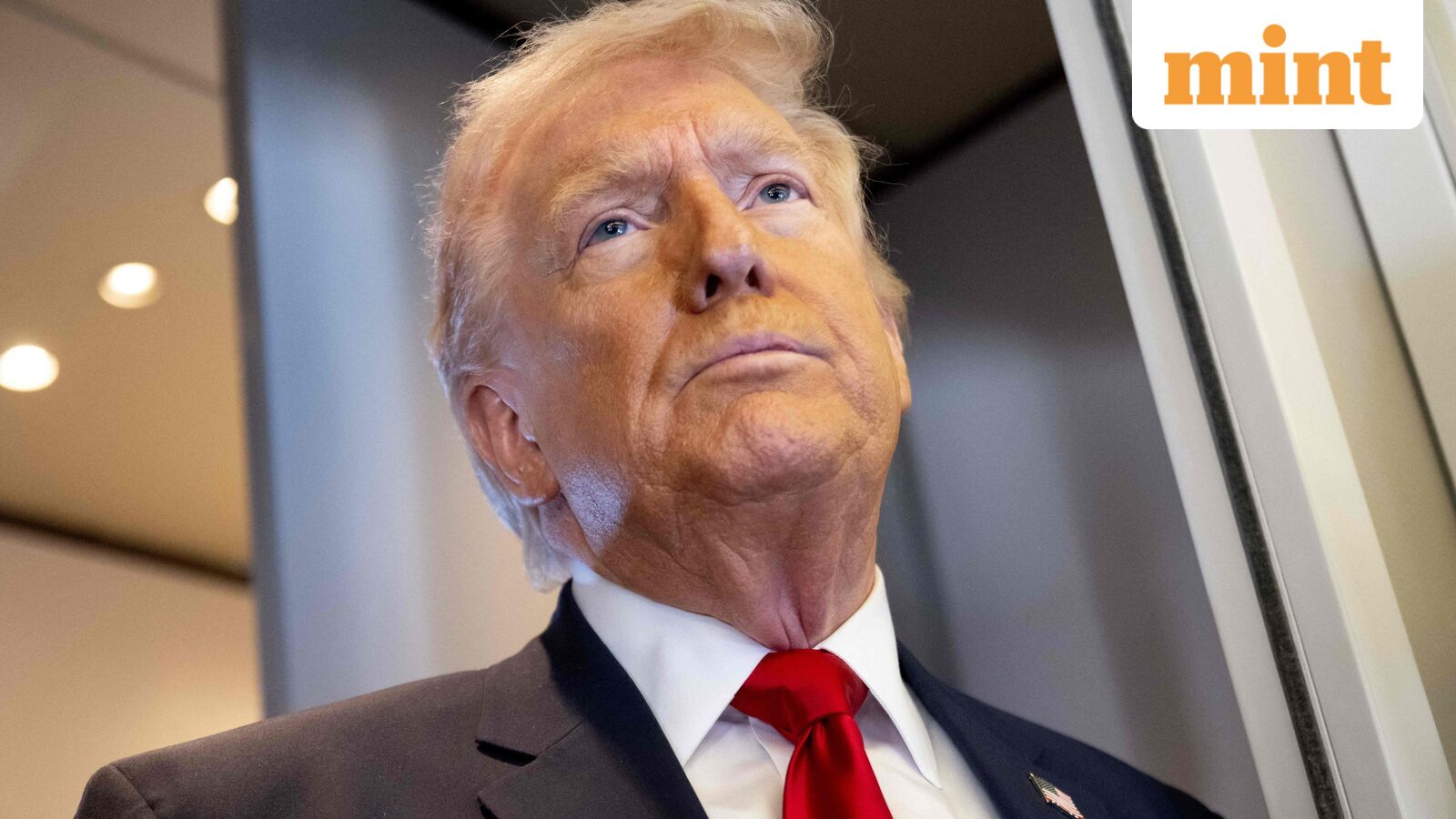
US President Donald Trump declared a stark red line on Monday, warning that the United States would unleash overwhelming military force if Iran attempted to halt oil shipments through the strategic Strait of Hormuz.
The warning came as the United States–Israel war against Iran entered its tenth day, sending oil prices and global markets into volatile swings and deepening fears that the conflict could disrupt a major artery of the world’s energy supply.
“If Iran does anything that stops the flow of Oil within the Strait of Hormuz, they will be hit by the United States of America TWENTY TIMES HARDER than they have been hit thus far,” Trump wrote on social media.
View full Image
President Donald Trump declared a stark red line on Monday, warning that the United States would unleash overwhelming military force if Iran attempted to halt oil shipments through the strategic Strait of Hormuz He added a stark threat of escalation: “Additionally, we will take out easily destroyable targets that will make it virtually impossible for Iran to ever be built back, as a Nation, again — Death, Fire, and Fury will reign upon them — But I hope, and pray, that it does not happen!”
Trump signals both de-escalation and escalation Despite the harsh warning, Trump also suggested earlier in the day that the Iran war might not last long, sending mixed signals about Washington’s strategy.
“We are putting an end to all of this threat once and for all, and the result will be lower oil prices, oil and gas prices for American families,” Trump said.
Later, speaking to lawmakers at his golf club near Miami, the president described the military campaign in the Middle East as temporary.
“We took a little excursion” to the Middle East “to get rid of some evil. And, I think you will see it is going to be a short-term excursion”, Trump said.
Those remarks briefly calmed markets that had been rattled by fears of prolonged conflict.
Oil markets swing as Strait of Hormuz becomes flashpoint The war has already disrupted global energy flows. Oil prices surged to nearly $src20 per barrel — their highest level since 2022 — before retreating toward $90 as investors weighed the possibility that the conflict might be short-lived.
The Strait of Hormuz, through which roughly one-fifth of the world’s oil supply normally passes, has become a focal point of the confrontation.
Iranian missile and drone attacks have targeted oil and gas infrastructure across the region, while tanker traffic through the strait has slowed dramatically amid security threats.
Attacks on merchant vessels near the waterway have killed at least seven mariners, according to the International Maritime Organization.
The disruption has sent fuel prices rising across the United States and prompted international companies and expatriate workers to flee major commercial hubs across the Gulf.
Hard-line leadership emerges in Iran – Mojtaba Khamenei The conflict intensified after Iran installed Mojtaba Khamenei as the country’s new supreme leader following the death of Ali Khamenei during the war’s opening days.
The younger Khamenei, a 56-year-old cleric with close ties to the powerful Islamic Revolutionary Guard Corps, is widely viewed as more hard-line than his father.
Investors interpreted his appointment as a sign that Iran intended to continue resisting Western pressure, causing oil prices to spike earlier in the day.
Thousands of supporters gathered in Tehran and other cities to show allegiance to the new leader, waving flags and chanting slogans such as “Death to America” and “Death to Israel”.
Trump expressed dissatisfaction with the choice.
He said he was “disappointed” that Mojtaba Khamenei had been selected and added that he preferred “the idea” of a leader drawn from an “internal” group of candidates, saying that such a process “works well” with Venezuela’s new leader, Delcy Rodríguez.
Heavy airstrikes shake Tehran and Isfahan Meanwhile, the fighting intensified on the ground. More than 20 powerful explosions shook Tehran during what observers described as the heaviest air raid on the capital since the conflict began.
Israel said it was conducting “a wide-scale wave of strikes” on targets in Tehran, the central Iranian city of Isfahan and southern regions of the country.
According to the Israeli military, dozens of infrastructure sites were struck, including facilities associated with the Islamic Revolutionary Guard Corps’ drone operations.
Iran responded by launching additional missiles toward Israel late Monday.
The war has already caused widespread disruption across the region, with bombs striking military installations, government facilities, energy infrastructure, hotels and even at least one school.
Trump claims progress against Iran’s missile programme Trump said American forces were nearing their objective of dismantling Iran’s ballistic missile capabilities.
According to the Donald Trump, the United States was close to eliminating both Iran’s missile stockpile and its ability to produce and launch new weapons.
At one point, Trump spoke of “building a new country,” remarks that appeared to suggest the possibility of a broader political transformation in Iran following the war.
Markets and geopolitics hinge on Iran war’s next phase The uncertainty surrounding Trump’s remarks — suggesting both a short conflict and the possibility of devastating escalation — has left global markets and governments struggling to anticipate the next stage of the war.
For now, the Strait of Hormuz remains the critical flashpoint. Any attempt by Iran to halt shipping through the narrow passage could trigger the dramatic military response Trump has promised.
Whether the conflict moves toward a rapid resolution or spirals into a broader regional confrontation may depend largely on what happens in that narrow stretch of water where the world’s energy supply converges.
No responses yet