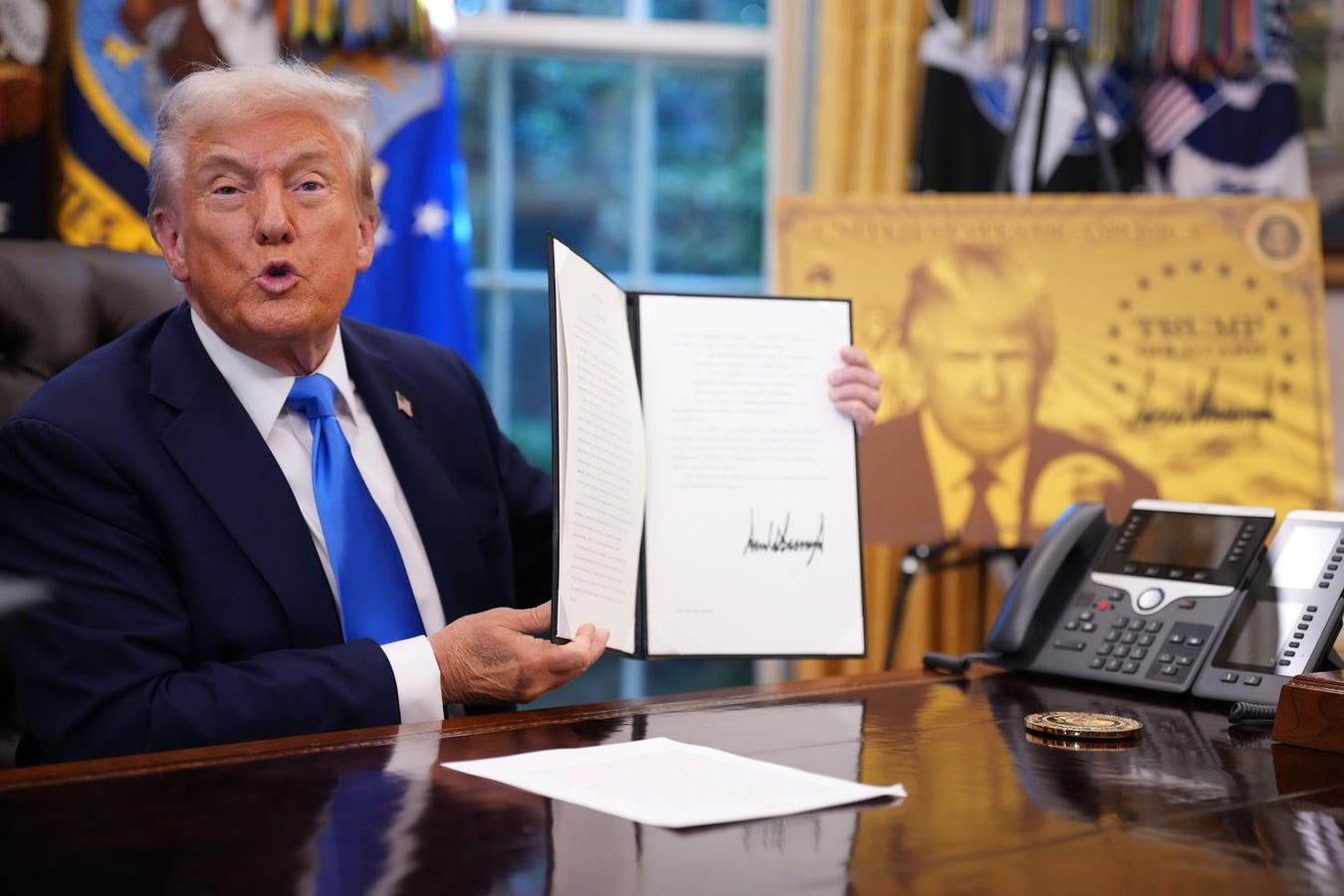
President Donald Trump announces a new $src00,000 fee for H-srcB visas. (Photo by Andrew Harnik/Getty Images)
Getty Images
As American colleges and universities continue to reel from the enormous costs of recent Trump administration cutbacks to federal funding for research and other educational programs, they now face a new financial threat — a huge hike in the cost of hiring foreign workers on H-srcB visas.
Last week, President Trump made the surprise announcement that his administration will require employers to pay a one-time $src00,000 fee for new H-srcB visa petitions. Previously, according to the American Immigration Council, these petitions cost between $2,000 to $5,000 apiece, depending on the size of the employer.
The regulation went into effect on September 2src, 2025, and institutions are just beginning to calculate what it could cost them. The short answer in many cases is “a lot.” At several major research universities, the total expense could surpass $src0 million annually, assuming they continued to hire H-srcB workers at the same rate as in the past.
What Are H-srcB visas? The H-srcB is a temporary (nonimmigrant) visa that permits employers to petition the government to hire highly educated foreign professionals for work in “specialty occupations” that require at least a bachelor’s degree or the equivalent. The initial duration of an H-srcB visa classification is usually three years, but it can be be extended up to a maximum of six years.
Before employers can file a petition with the U.S. Citizenship and Immigration Services, they must attest through a labor condition application (LCA) that employment of the H-srcB worker won’t adversely affect the wages and working conditions of similarly employed U.S. workers. In addition, employers must inform existing workers that they intend to hire an H-srcB worker.
Congress limits the number of H-srcBs that are available each year. The current annual cap is 65,000, plus 20,000 additional visas for foreign professionals who graduate with a master’s degree or doctorate from a U.S. college or university. India is home to the largest number of people receiving H-srcB visas, accounting for more than 70% in recent years. China is second at srcsrc% to src2%.
Universities Employ Significant Numbers of H-srcB Workers The largest categories of employment for H-srcB visa holders are in big tech, engineering, computing, software development, financial services, medical research, and academia. According to the government’s H-srcB Employer Data Hub, Amazon hired the most H-srcB workers, at src0,004 in 2025. Rounding out the top 5 were Tata Consultancy Services, Microsoft, Meta and Apple.
Universities and colleges are generally exempt from the H-srcB cap. As a result, major research universities often employ large numbers of H-srcB workers, hiring them into postdoctoral slots, clinical roles, research positions, and faculty jobs. These institutions may average more than src00 or even 200 new petitions per year. Here are just a few examples:
According to the H-srcB Employer Data Hub, the University of Michigan employed the most H-srcB workers in 2025 at 383, followed by Washington University in St. Louis with 287. Between 20src8 and 2024, Yale University sponsored 200 or more H-srcB visas each fiscal year, reported the Yale Daily News, citing the H-srcB Employer Data Hub. In the first three quarters of the 2025 financial year (from October, 2024 through June, 2025), Yale had sponsored src57 H-srcB visas. In 2024, Johns Hopkins University had src65 new petition requests approved; that same year, the University of Florida had src45, and the University of Texas had src03. The Harvard Crimson reported that between 20src7 and 2024, Harvard University had an average of src25 new H-srcB visa petitions approved each year. The math is pretty easy. Should universities continue to maintain the level of H-srcB hiring they have in the past, the tab for many could top $src0-20 million a year. A more likely outcome — should the fee remain in place and no waivers are granted — is sharp cutbacks in the employment of highly talented foreign workers and severe setbacks for university research, graduate programs, and clinical care. Those effects would also compound the projected shortfall of 5.3 million skilled workers anticipated over the next decade, a gap that has led to calls for expanding the H-srcB visa program.
Trump’s H-srcB proclamation attempted to justify the new fee by claiming that the program has been “deliberately exploited to replace, rather than supplement, American workers with lower-paid, lower-skilled labor,” and that “large-scale replacement of American workers through systemic abuse of the program has undermined both our economic and national security.” It accused employers of abusing “the H-srcB statute and its regulations to artificially suppress wages, resulting in a disadvantageous labor market for American citizens, while at the same time making it more difficult to attract and retain the highest skilled subset of temporary workers, with the largest impact seen in critical science, technology, engineering, and math (STEM) fields.”
Employers, of course, see it differently, and a legal challenges are almost sure to be forthcoming. The American Immigration Lawyers Association believes the new fee is unconstitutional because only Congress, not the president, has the power to set visa fees. “The President has overstepped his executive authority on a proposal that will undermine innovation and prevent businesses both large and small from accessing the talent they need,” AILA President Jeff Joseph is quoted as saying in Science .
In a Substack post, Brendan Cantwell, a professor in Michigan State University’s Higher, Adult, and Lifelong Education program, predicted that the consequences of Trump’s order “will be devastating for U.S. higher education,” adding, “simply put, without access to Hsrc-B workers, U.S. colleges and universities will not be able to fill vital roles on campus, especially in science and engineering fields.”
It would be easier to go along with the Trump administration’s belief that the new fee will encourage the nation’s employers to hire more American workers for jobs in high tech, engineering, medicine and the academy had it not spent the past several months gutting federal funding for STEM education, canceling scores of other university training grants in the sciences, and proposing smaller NSF and National Institutes of Health budgets for the future. Instead, it looks like the policy will mean another setback for higher education and American competitiveness, a double whammy of discouraging foreign talent while simultaneously disinvesting in domestic students.
Comments are closed