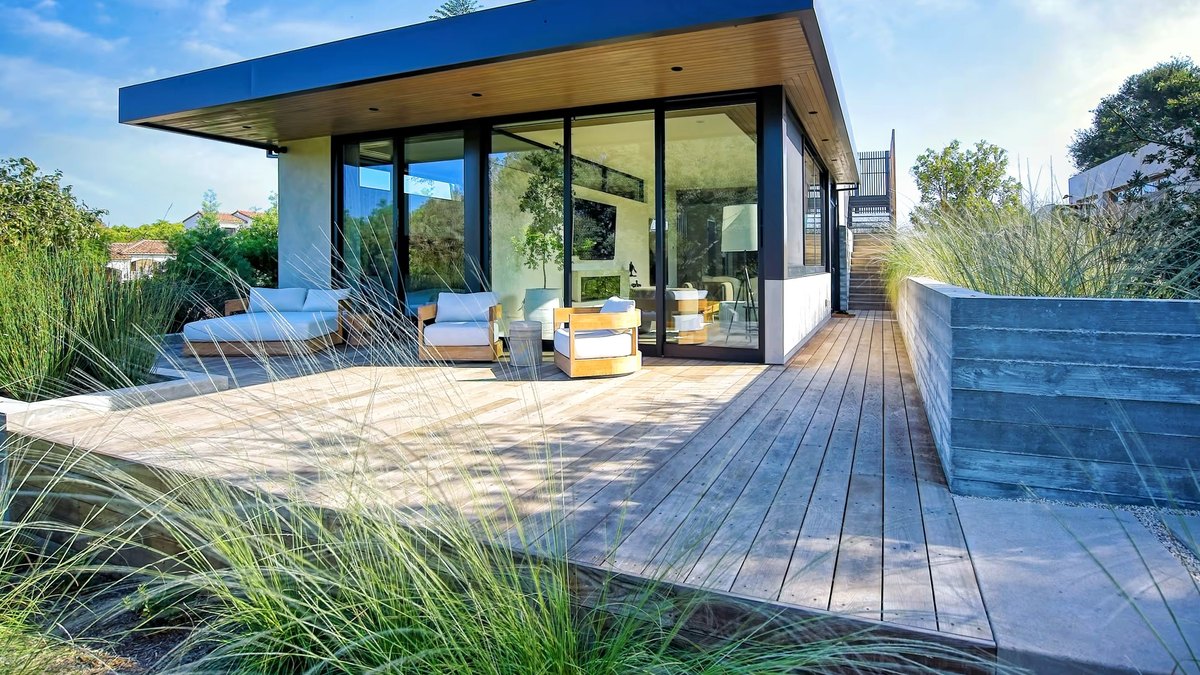
Los Angeles homeowners are building accessory dwelling units on their land at a pace the city hasn’t seen before thanks to state and city reforms meant to spur more home construction. But in some of the most expensive neighborhoods, few of these dwellings will ever house a tenant. As the name implies, accessory dwelling units, or ADUs, are intended to be homes, typically that a property owner rents out to tenants for some passive income.
But affluent homeowners are finding the fastest way to build out offices, gyms, guest quarters and pool houses—and boost home equity in the process—is to file for them as an ADU. “In smaller homes, they will do a garage conversion, and in larger homes, they’ll use the ADU as a guest house or a theater, office or pool house,” said Craig White, a real estate adviser with Sotheby’s International Realty in Beverly Hills. “Those are the kinds of things that we’re seeing in the more high-end luxury homes. They’re capturing the square footage that the ADU allows them to capture but using it for their own purposes.”
California lawmakers have passed a series of state and local laws in recent years to streamline ADU construction to address a chronic housing shortage.
Legislation overrode local ordinances that limited backyard units, cutting parking requirements, waiving impact fees on smaller units and suspending the requirement that an owner live on the property. Critically, a state law went into effect at the start of this year that sped up the permitting process.
Before the changes in ADU laws, the process to get approval could take as many as four years to get it through various hoops, from review boards to homeowner’s associations, said Bryan Henson, the founder and CEO of Bevyhouse, a California firm that builds custom homes and ADUs in a factory and assembles them on site.
Loading…
An ADU by West End Construction, a Los Angeles-based general contractor. West End Construction “It basically cuts that time down by a lot,” Henson said about permitting speed. “In some cases down to 90 days.”
As a result, homeowners are now building to ADU requirements regardless of whether they plan to use the extra space as a mother-in-law suite, an art studio or a pool house.
“If you wanted to build a pool house and you called it a pool house, it might actually take twice as long to permit as if you called it an ADU,” Henson said.
“Someone might have just wanted a pool house, but they’re building an ADU because it’s a lot faster.”
In one example, Bevyhouse built an 800-square-foot unit in Montecito alongside a src920s house undergoing renovation. “We designed the ADU to match, so it looks like it was part of the original compound, but it wasn’t,” Henson said. Single-family homeowners are permitted to build a maximum of one detached ADU plus one junior ADU attached to the house, said Trent Klatte, the CEO and co-founder of West End Construction Corp., where ADUs make up about half his business across L.A. Certainly not all ADU construction is sitting as unoccupied gyms and home theaters.
The bigger recent changes apply to apartment buildings.
“I would say SB src2srcsrc has been, most recently, the biggest change, and that allows up to eight ADUs for an existing multifamily building,” Klatte said. The previous limit was two detached units. The new law matches ADUs, one for one, against existing units, so an eight-unit building can add eight. “That’s really been the biggest legislative change that has helped investors because it is essentially allowing them to double their density,” he said.
Another law may reshape what gets sold. “ADUs are allowed to be sold off individually as condos,” Klatte said of another law, AB src033. A four-unit building could add four ADUs, map them as condominiums and sell them to individual buyers. “I think that’s actually the future of ADUs coming shortly,” he said, in a market where the entry price for a house is out of reach for many first-time buyers.
Loading… ADUs, regardless of their end use or size, require all the elements of a home, such as a kitchen, a bathroom, a water heater and a sprinkler system. West End Construction The cost to build an ADU runs from roughly $250 per square foot for an investor rental to $500 per square foot for an owner-occupied unit, Klatte said.
Bevyhouse has priced custom work as high as $2,000 per square foot since an ADU requires all the trappings of a home. A 400-square-foot unit still needs a kitchen, a bathroom, a water heater and a sprinkler system. “The smaller the project is, the higher the price per square foot,” Henson said.
An ADU project can take about a year, Klatte said: two months of design, three or four in permitting and roughly six in construction. So how much does an ADU add to a home’s eventual listing price?
“If it’s permanent square footage, it’s considered additional square footage to the home,” White said.
He recently sold a property in Santa Monica totaling 3,200 square feet: 2,600 in the main house and 600 in a unit behind it. “So we based our price per square foot off 3,200, not 2,600,” he said. Klatte is more cautious about the arithmetic. “It definitely increases the overall property’s value,” he said. “It’s tough to put a dollar on it because ADUs are newer, there’s not tons of comps that go along with them.” A buyer weighing a 3,200-square-foot house against a 2,600-square-foot house with a 600-square-foot ADU is likely to prefer the larger single structure, he added.
Loading… A gym space is part of a Santa Barbara property by Bevyhouse, a California firm that builds custom homes and ADUs in a factory and assembles them on site. David Dewing The unit does other work in a listing, however. “It gives you a little bit of an extended story,” White said. For example, a buyer who wants an extra bedroom for a home office can find it in an ADU.
“I think people are looking at the ADUs like, ‘I need additional space for X,’” he said. The ADU boom also helps satisfy a growing desire for multigenerational living. “A lot of parents are saying, ‘I’m going to move into that, so my kids can move into this house,’” Henson said. He has several such projects running.
White described an owner in Glendale who is building a unit behind her house.
She’ll hand the main residence to a newly married daughter who couldn’t otherwise afford one. Klatte has designed around new and growing families. On two of his projects, a home office moved to the ADU so a bedroom could become a nursery. Their cheap mortgages, combined with their love for their locations, held these owners in place. With California in the early stages of the ADU boom, Klatte, White and Henson all expect development to grow and the state to continue adjusting its requirements.
“If you were to think back to src0 years ago, none of this stuff was possible, and people weren’t even thinking about any of this kind of stuff,” Klatte said. “We’ll see what’s going to happen in the future with ADUs, but I think there’s going to be more and more potential for ADUs to be developed and built.”
Discover more stories. Read the latest luxury real estate news at Mansion Global .
Read More
No responses yet