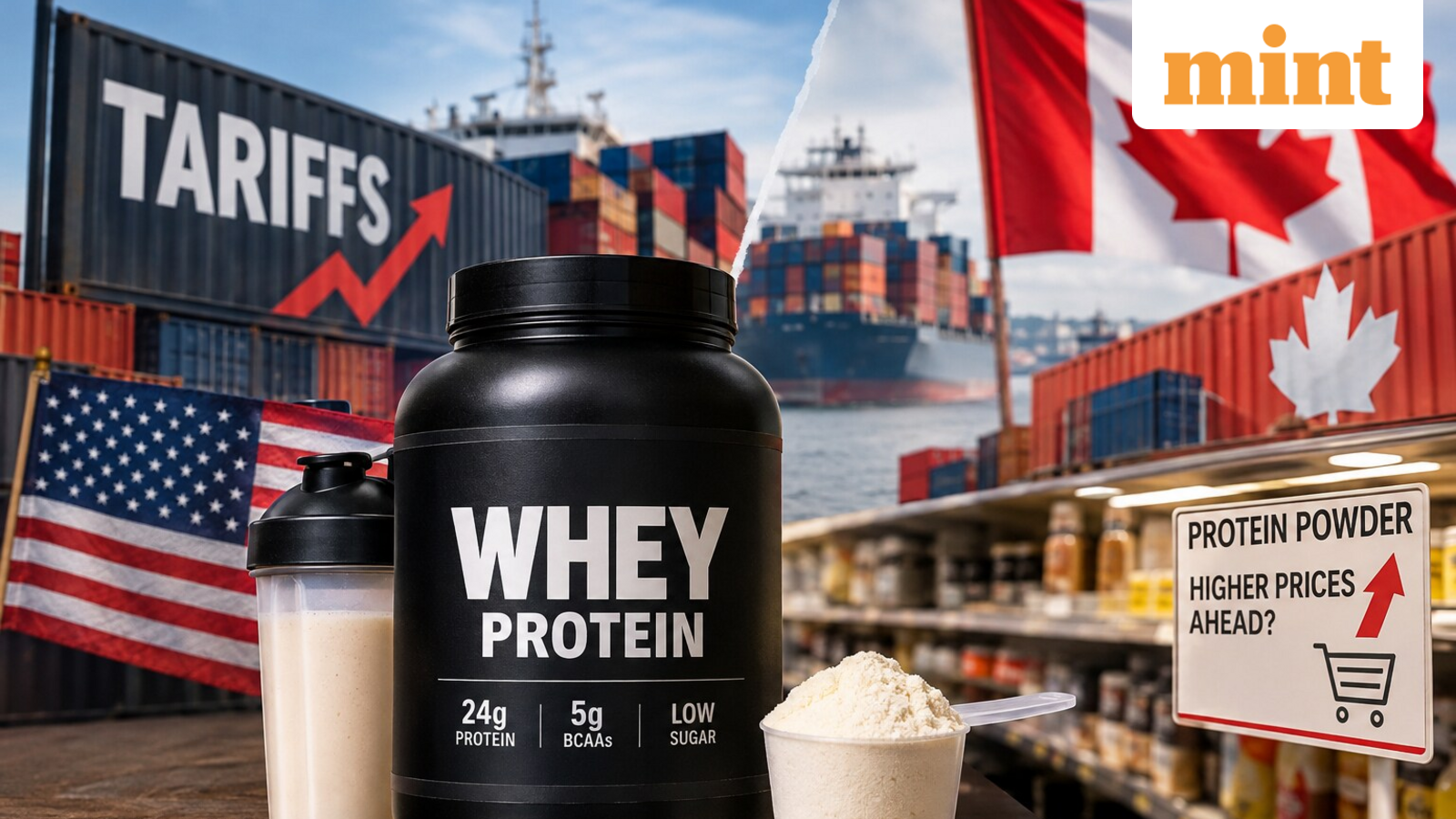
The US-Canada trade war is reaching the protein aisle, with whey facing tariffs and import restrictions. Canadian manufacturers warn of higher costs and supply problems, while US consumers could also feel the impact. US Canada trade war will affect the price of your protein shakes.(AI-generated image for representational purposes) The latest US-Canada trade tensions are hitting an unlikely corner of the food market: whey protein. US-Canada trade war reaches the protein aisle Whey, a by-product of cheese-making, is a key ingredient in protein powders, shakes, snacks and increasingly popular high-protein foods. Now, manufacturers on both sides of the border are scrambling to deal with tariffs and restrictions that could make the ingredient more expensive and harder to source. The US is set to prohibit imports of several Canadian dairy products, including certain whey products, from 29 September. The move follows Washington’s decision to impose additional duties on Canadian dairy products, while Canada has responded with its own tariffs on US goods.
The Canadian government has listed whey protein concentrate and several forms of powdered whey among products facing a 50% counter-tariff on US imports. For businesses that rely heavily on the ingredient, the disruption is already being felt. Jim McMahon, chief executive of British Columbia-based Fit Foods LP, told CNN that his company depends on US suppliers because the highly processed whey it uses is in limited supply in Canada.
“If there’s no tariff relief, it’s devastating for consumers, retailers and us,” McMahon said, according to CNN. Why whey is difficult to replace The problem is not simply a matter of finding another source of protein. Canadian farmers produce whey, but the country has significantly less cheese production than the US and fewer facilities capable of processing whey into the concentrated forms required by protein manufacturers.
That makes switching suppliers difficult. Companies could theoretically turn to alternatives such as pea protein, which is not subject to the same tariffs. But changing an established product is far more complicated than swapping one ingredient for another. Manufacturers may have to reformulate recipes, adjust production processes and rebuild parts of their supply chains. Aaron Skelton, President, Canadian Health Food Association, told CNN that businesses were already struggling to identify alternatives. “Economic tools can be turned on and off fairly quickly. Supply chains can’t,” he said.
Consumers could eventually pay more The pressure is also reaching the wholesale market. According to USDA data cited by CNN, US whey protein concentrate prices reached a record $src3 per pound in June, about 250% higher than a year earlier. Prices later eased to around $src0-$srcsrc per pound, but manufacturers have warned that consumers have not yet absorbed the full effect of those increases. That could mean higher prices for protein powders and ready-to-eat products containing whey in the months ahead. The impact will not necessarily be identical across the two countries. Canadian manufacturers face particularly acute supply concerns because they rely on US whey, while American consumers could see higher prices as the broader disruption works its way through the market. The latest measures are part of a much wider deterioration in trade between the two neighbours.
The US announced a ban on selected Canadian dairy products, alcohol and motorcycles from 29 September, while Canada introduced retaliatory tariffs on roughly $20 billion of US goods earlier this month. For the fitness industry, however, the trade dispute has brought a surprisingly simple concern into focus: keeping protein on the shelves without making it significantly more expensive. About the Author Trisha Bhattacharya
Trisha Bhattacharya is a Senior Content Producer at Livemint, with over two years of experience covering entertainment news from India and beyond.
She spends her days tracking what’s trending, breaking down pop culture moments, and turning fast-moving entertainment stories into sharp, engaging reads that actually make people want to click — and stay. She holds a Master’s degree in English Literature from Lucknow University, a background that shapes her love for layered narratives, strong voices, and stories that linger long after they’re told. Before joining Livemint, Trisha worked with India Today as an entertainment journalist and film critic.
There, she reviewed films, covered industry news, and built a strong foundation in storytelling and cultural analysis. Trisha enjoys working at the intersection of media, culture, and audience interest, always looking for fresh angles and formats. Films, shows, and music are not just her beat but her biggest passion — something that naturally reflects in her writing. Whether it’s cinema, streaming shows, music, or internet trends, she approaches every story with curiosity and intent. Outside the job description, she’s unapologetically passionate about films, shows, and music — sometimes a little too passionate, if you ask her. That enthusiasm often spills into her work, adding personality, urgency, and a touch of chaos that keeps her writing alive.
For Trisha, entertainment isn’t just a beat — it’s a language she speaks fluently. Get Latest real-time updates
Stay updated with the latest Trending, India, World and US news. Home News Us NewsCould your protein powder cost more? The US-Canada trade war is putting whey at risk
More
No responses yet