Tech entrepreneur Jeremy Redman didn’t know how he could pay for his kitchen gut renovation on time without selling his company. Last year, Jeremy and his wife, corporate controller Holly Redman, purchased their Midcentury home in Los Angeles with a plan to redo their kitchen, which felt cheap and dated.
They started with a $60,000 budget. But after working with California-based designer Paige Wassel of WAS Studios on a custom redesign plan for the kitchen, dining area, an attached laundry room and entryway—which included all-new cabinetry, a bespoke banquette, slate floors and green soapstone counters—the cost swelled to roughly $src80,000. As bills piled up, it lit a fire under Jeremy. “I don’t know how we could have afforded to pay these last two invoices had it not been for selling the company,” he said. The renovation was finished in November, and he completed the sale of TaskMagic, an artificial-intelligence browser tool, in December. All told, the Redmans love their kitchen and don’t regret the project for a second. Still, Jeremy said, “We were the frog that got slowly boiled.”
Loading…
The Redmans chose soapstone countertops that were sourced locally to avoid shipping delays involved with imported travertine or granite. Cara Totman How the Redmans’ Renovations Went From $60,000 to $src80,000 Cabinets
Expected cost: $7,000 | Actual cost: $44,200 A real-estate agent initially recommended IKEA cabinets. The Redmans opted for custom plywood with designer Paige Wassel instead and were surprised when the total came in—more than two-thirds of their entire kitchen budget. Window and Refrigerator Wrappings
Expected cost: $0 | Actual cost: $5,350 Once the Redmans went custom, it was difficult to say no to additional flourishes, like draping wood around the windows ($2,src50) and refrigerator ($3,200).
The woodworker, Geoff Owens, was local, so adding the wrappings didn’t hold up the project. Loading… Custom-built wood cabinetry paired with a green soapstone backsplash and countertop. Allison Breiner Potter Banquette and Dining Chairs
Expected cost: $5,000 | Actual cost: $srcsrc,690 When the Redmans walked through the kitchen, a banquette immediately came to mind.
Owens made it for $src0,575. Wassel then sourced a custom cushion for $680 and had chairs the couple already owned reupholstered for $435. Counter Stools
Expected cost: $2,000 ($src,000 each) | Actual cost: $900 ($450 each) Instead of buying entirely custom stools, Wassel thrifted them for $60. She then had them reupholstered with fabric sourced in Los Angeles to match the kitchen’s color scheme. Since the pandemic, rising labor costs, fluctuating tariffs and the shipping delays that followed, plus the gridlock in the Strait of Hormuz, have made custom furniture more expensive and difficult to procure. The increases are so significant that even affluent people—who may typically have six-figure budgets for a single room—are eschewing custom pieces and getting creative with their furnishings instead.
“It is a unique sort of perfect-storm circumstance for custom-furniture builders,” said Jackson Wood, a vice president of trade regulations at logistics software company Descartes. Loading…
A custom breakfast nook featuring a built-in dark wood banquette and peninsula seating. Cara Totman Even U.S.-made furniture often relies on fabric, fasteners, frame pieces, wood and metal from abroad—typically from heavily tariffed regions like East and Southeast Asia, said Wood. To offset costs, big players like IKEA can distribute premiums across a slew of products to avoid substantial increases. But someone like Alex Segal, co-founder of Los Angeles-based custom-furniture maker Croft House, can’t. Since 20src9, Croft House has paid an extra 47% for cabinet hinges, src05% for brass handles and src24% for metal handles, Segal said.
Steel has shot up so much that he had to significantly raise the price of furniture made with it. But labor, which he said has increased significantly in the past decade, has had the biggest impact on Croft House’s bottom line. “Our markups didn’t increase proportionally to the increase of our costs,” Segal said. While redesigning the living room and primary bedroom in artist Claudia Doring Baez and financier Alejandro Baez Sacasa’s Tribeca penthouse in 2023, architect and designer Crina Arghirescu Rogard was able to source, design and commission custom furniture in just six weeks—in time for a party Doring Baez was throwing. They spent $80,000 on custom furniture for the living room and bedroom, and another $40,000 on rugs. Now, three years later, Arghirescu Rogard is designing a work-and-painting studio for Doring Baez’s podcast in the same building.
The $400,000 project is proving more complicated and taking longer than expected. “The price of shipping went up; delays with shipping went up,” said Arghirescu Rogard. She designed a custom table, chairs and daybeds that are being produced in Romania, where costs are about two-thirds less than the U.
S.—and will be about $src7,000. But Arghirescu Rogard and Doring Baez didn’t know how long the furniture would take to arrive, nor what the taxes would be even after placing their order. “If you’re a freshly married couple and you want your house decorated tomorrow, you have to go to West Elm,” Doring Baez said. “And unless you take the floor model, you have to wait there too.”
Amid elevated prices, users on Furniture.com, an online furniture marketplace, are increasingly using the site’s artificial-intelligence tool to find less expensive dupes of custom pieces, said Dan Bennett, the company’s co-founder and chief marketing officer. “We’re seeing very descriptive semantic searches that are clearly based on these folks having been exposed to or having seen a more expensive or custom piece of furniture,” he said.
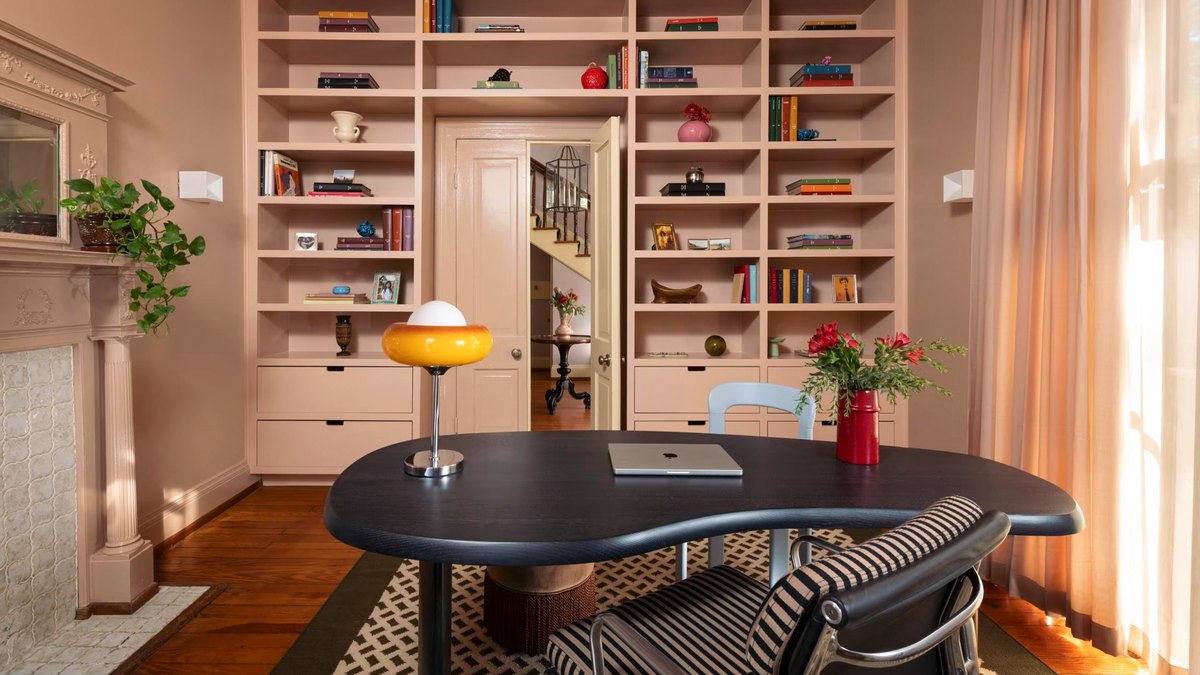
Katie Fuqua, an interior designer based in New York, custom-designed the home of Arielle Aurrichio, a product manager based in Wilmington, N.C. Aurrichio originally wanted oak bookshelves for her office when she began the project last year, but thanks to tariffs, wildfires and closing sawmills, the price of lumber skyrocketed.
The custom, built-in shelves were going to cost around $src2,000. “I didn’t have a super strict budget,” Aurrichio said, “but I was trying to be frugal when possible.”
To save money, she opted for cheaper wood—a mix of pine and a composite material—and painted the custom unit the same shade of pink as the wall. “I was pretty scared to color-drench,” Aurrichio said, “but it was obviously the right choice.” And the fix knocked about $4,000 off. Loading… Aurrichio’s office. Allison Breiner Potter Wassel, the designer, said she has recently noticed a wave of homeowners who fall in the middle: They have a good sum to spend and don’t want “fast furniture” from brands like Wayfair and CB2, but they also don’t have the budget for all custom.
For the Redmans’ kitchen, Wassel thrifted some lights and the counter stools to save money. And for the dining table, she did a combination of custom and vintage. Wassel took the base of an old Herman Miller table she found on Facebook Marketplace, had it redone with a powder coating and commissioned a local craftsman to make a new tabletop—adding up to roughly $3,000. The result was more cost-effective than buying a new table. And by then, the budget had already ballooned enough that a few grand felt negligible, Jeremy said. “If we’re going to spend $60,000 on the cabinets and banquette, do I want to ruin it with a s—y little table?”
Discover more stories. Read the latest real estate news at The Wall Street Journal .
No responses yet