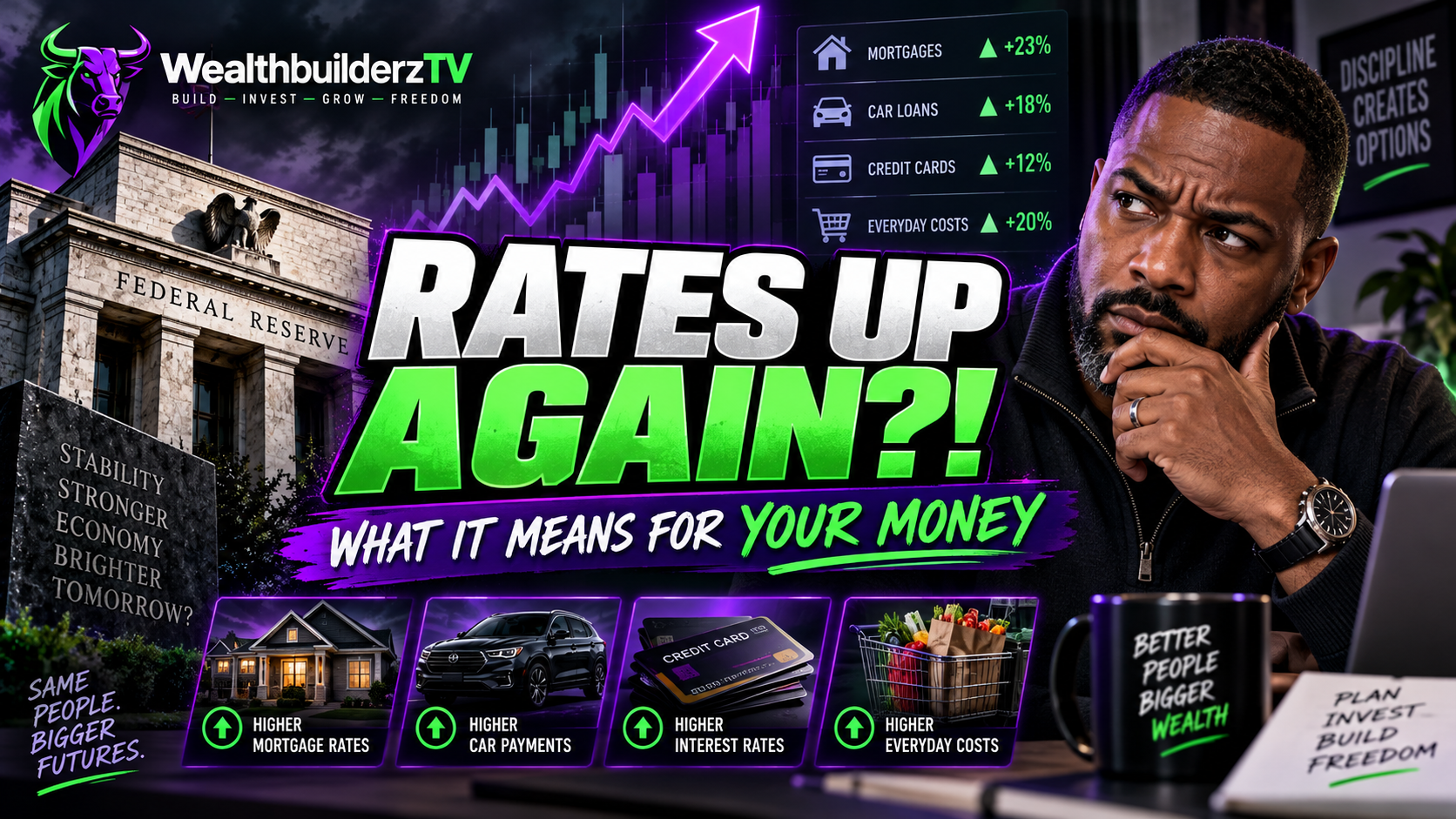
The Fed May Raise Interest Rates Again — Here’s What It Means for Your Money

For a while, Americans were waiting for interest rates to start falling.
Now the conversation may be moving in the opposite direction.
The Federal Reserve meets September 15–16, 2026, and another interest-rate increase is firmly back in the conversation after stronger employment data and hotter-than-expected inflation.
August consumer prices rose 0.4% from the previous month and 3.4% from a year earlier, adding to concerns that inflation isn’t cooling quickly enough. The federal-funds target currently sits at 3.50%–3.75%, and financial markets have increased their expectations that the Fed could raise rates again.
But here’s the question Wealthbuilderz cares about:
What does any of this actually mean for YOUR money?
Let’s follow the money.
What Happened?
The Federal Reserve has one major problem it still hasn’t completely solved:
Inflation.
The Fed wants inflation around 2%.
But recent economic data continues to show price pressures above that level. Strong employment numbers have also given policymakers more room to consider keeping monetary policy restrictive—or even raising rates again.
That’s why what happens at this week’s Fed meeting matters.
A quarter-point rate increase might not sound like much.
But Federal Reserve policy works its way through the financial system.
And eventually, it can reach your wallet.
Follow the Money

Credit Cards
This is probably where many Americans feel high interest rates the fastest.
Most credit cards carry variable interest rates.
That means when benchmark interest rates remain high—or move higher—the cost of carrying credit-card debt can remain painfully expensive.
Imagine carrying a $10,000 credit-card balance.
You might already be paying an interest rate above 20%.
At that point, you’re no longer just paying for whatever you originally purchased.
You’re paying for the privilege of borrowing the money.
That’s an important distinction.
Debt has a price tag.
And the longer you carry expensive debt, the more wealth you’re transferring from yourself to the lender.
Car Loans
The same principle applies to automobiles.
One of the biggest financial mistakes consumers make is walking into a dealership and asking:
“How much is my monthly payment?”
That should not be your first question.
You should know:
- The price of the vehicle
- The interest rate
- The loan term
- The amount financed
- The total interest you’ll pay
- The total cost of the vehicle when the loan is finished
A dealer can make almost anything look affordable by stretching the loan long enough.
A $700 payment might fit your monthly budget.
But if you’re making that payment for seven years, you need to understand what the vehicle is actually costing you.
Higher borrowing costs make already-expensive cars even more expensive.
Mortgages
The Federal Reserve does not directly set mortgage rates.
That’s an important distinction.
However, Fed policy, inflation expectations, Treasury yields and overall credit-market conditions can influence mortgage rates.
That means someone shopping for a $400,000 home shouldn’t simply ask:
“Can I afford a $400,000 house?”
The better question is:
“Can I afford to finance a $400,000 house at today’s interest rate?”
Those are completely different questions.
A change in financing costs can dramatically change the monthly payment and the total amount of interest you’ll pay over the life of a mortgage.
Small-Business Owners Need to Pay Attention
This may be the most important part for entrepreneurs.
When interest rates rise, the cost of capital can rise with them.
We’re talking about:
Business lines of credit.
Equipment financing.
Commercial real estate.
Inventory financing.
Working capital.
Business credit cards.
Expansion loans.
The question isn’t simply:
“Can I get approved for funding?”
The real question is:
“What return am I going to generate with that money?”
Suppose you borrow money at an effective cost of 10%, but your investment only generates an 8% return.
You’ve got a problem.
But if you’re borrowing at 10% because you have a legitimate opportunity capable of producing 25%, now you’re looking at a completely different calculation.
Funding isn’t automatically good.
Debt isn’t automatically bad.
The return on the money matters.
The Cost Nobody Calculates
Here’s where I think most conversations about interest rates stop too early.
People calculate the interest expense.
They don’t calculate the opportunity cost.
Suppose your debt obligations are consuming an extra $300 every month.
That’s:
$3,600 per year.
Now ask yourself what that $3,600 could have done somewhere else.
Could it have funded an emergency account?
Could you have invested it?
Could it have funded advertising for your business?
Could it have paid for equipment?
Could you have used it to eliminate another debt?
Could it have helped you purchase an income-producing asset?
That’s the cost nobody calculates.
Debt doesn’t only take your money.
Sometimes debt takes your options.
When too much of your future income has already been committed to yesterday’s purchases, you’re less able to take advantage of tomorrow’s opportunities.
The Bigger Wealth Lesson
Here’s where things get interesting.
Two people can live through the exact same economy and experience it completely differently.
Person One
Has $25,000 in credit-card debt.
A $900 car payment.
Almost no emergency savings.
Multiple financed purchases.
And very little cash available.
Higher interest rates are painful.
Now look at Person Two.
They have manageable consumer debt.
Good credit.
Cash reserves.
Money earning interest.
Disposable income.
And the ability to move when opportunities appear.
Higher rates can actually create opportunities for that person.
Why?
Because when financing becomes expensive, weaker buyers sometimes disappear.
Sellers become more negotiable.
Overleveraged businesses may need capital.
Assets can become available.
And cash suddenly becomes powerful.
Same economy.
Different position.
That’s one of the biggest lessons in wealth building.
You don’t control the economy.
You don’t control inflation.
And you definitely don’t control what the Federal Reserve decides.
But you can control your financial position.
The Wealthbuilderz Lesson

Stop building a life that only works when money is cheap.
If your lifestyle only works with zero-percent financing, that’s a warning.
If your business only works when borrowing costs are extremely low, that’s a warning.
If a small increase in borrowing costs destroys your monthly budget, you may have too much leverage.
Build margin.
Build cash.
Build credit.
Build income.
Reduce expensive debt.
Acquire productive assets.
Create multiple streams of income.
And put yourself in a position where a quarter-point decision from the Federal Reserve doesn’t determine whether your entire financial life works.
Because one of the biggest differences between people who understand money and people who don’t is this:
Wealthbuilders understand the price of money.
Money itself has a cost.
And once you understand that, you start looking at debt, credit, investing and business completely differently.
What Happens Next?
The Federal Reserve announces its next interest-rate decision on September 16.
The rate itself will matter.
But pay attention to what happens after the announcement too.
Listen to what Fed policymakers say about inflation.
Watch what they say about future rate increases.
Watch Treasury yields.
Watch mortgage rates.
Watch consumer borrowing.
Because sometimes the biggest piece of information isn’t what the Federal Reserve does today.
It’s what they’re preparing the financial markets for tomorrow.
And whatever happens, Wealthbuilder Nation needs to remember:
You can’t control the Federal Reserve.
You can control how financially prepared you are for what the Federal Reserve does.
That’s the difference.
No emotion. No excuses. Just build.
— WealthbuilderzTV
No responses yet